Aerospike earns dual recognition in the 2026 Gartner Hype Cycle for data management
Aerospike is recognized as a Sample Vendor in both operational intelligence and distributed transactional databases in the 2026 Gartner Hype Cycle for Data Management, with both categories now on the Plateau of Productivity.
Steve Tuohy Director of Product Marketing Published October 13, 2026 Read time 6 min read
In the 2026 Hype Cycle for Data Management, that climb is complete.
Aerospike is again recognized as a Sample Vendor in both categories, and this year both are placed on the Plateau of Productivity. Operational intelligence is on the Plateau, while distributed transactional databases are entering it, now rated “mature mainstream” with more than 50% market penetration of their target audience. The two capabilities that defined Aerospike's recognition last year have converged at the same stage of maturity, the stage Gartner associates with proven, mainstream adoption.
Gartner's own Priority Matrix reinforces the point. It places both operational intelligence and distributed transactional databases in the high benefit tier, with less than two years to mainstream adoption. These are not emerging bets. They are capabilities enterprises are expected to adopt now.
Why 2026 is the year both reached the Plateau of Productivity
This year's report is defined around a change in what enterprises are asking of their data infrastructure. Gartner identifies the rise of AI agents and agentic data management, a growing focus on context layers, and an intensifying concern with data sovereignty as the forces affecting the category. Operational intelligence and distributed transactional databases are where those forces meet the transactional core of the business.
As intelligence moves into live operations, the ability to act on current data inside the transaction, and to keep that data consistent across regions, stops being specialized and becomes foundational. The curve is catching up to what demanding real-time systems have required for years.
Operational intelligence: Now on the Plateau of Productivity
Gartner defines operational intelligence as analytical processing embedded within transaction-like, near-real-time workloads, running analytics, AI, and machine learning inside the transaction flow rather than in a separate system downstream. Its arrival on the Plateau of Productivity marks it as a mainstream expectation rather than a specialized use case.
This change was inevitable as AI moved into enterprise operations, said Aerospike CEO Don Dama; he draws the distinction that explains why. Intelligence is “the quality of reasoning,” but operational intelligence is that reasoning applied to the enterprise's current state and context when a decision is required, he explained in a recent piece on operational AI. A model can reason brilliantly and still act poorly, “if the reality presented to it is incomplete or stale,” he said.
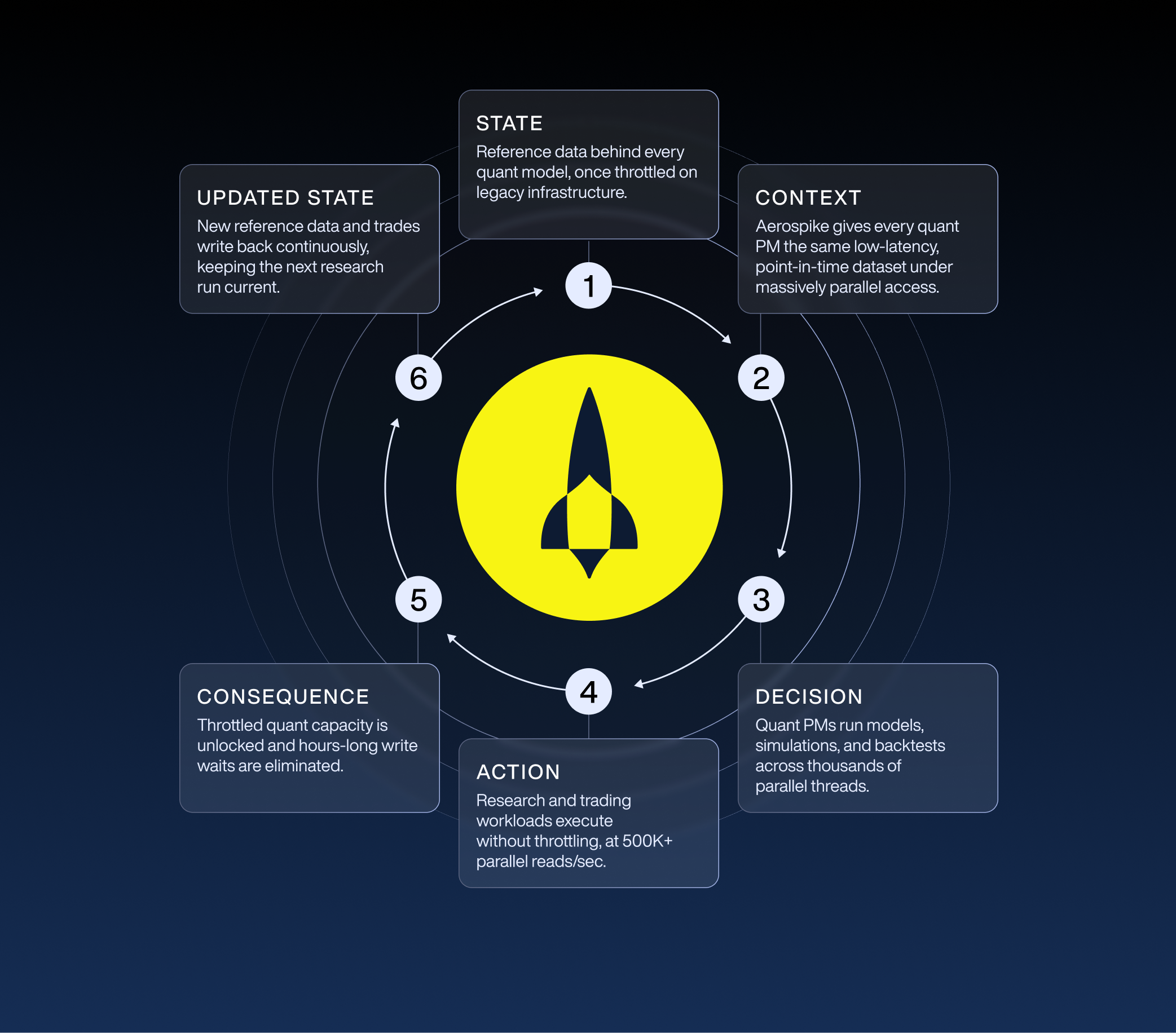
Figure 1: The Aerospike operating loop, running against reference data at a top ten multi-strategy hedge fund.
The work is a continuous loop: state, context, decision, action, consequence, and back to an updated state, Dama explained. A vital section of that loop is “updated state,” because an action does not just complete a workflow; it changes enterprise reality, and the next decision must begin from the reality the last one created.
The arrival of AI “did not create an entirely new architectural problem,” but made an existing one universal, Dama explained. A discipline once confined to a handful of demanding real-time systems is now a mainstream requirement, which is what a move onto the Plateau represents.
Aerospike delivers this in production. Its patented Hybrid Memory Architecture supports transactional access in one system, placing indexes in memory, persisting data on SSD, and retrieving at single-digit millisecond latency, which provides low-latency operational access and reduces the need for a separate caching layer.
Two examples show the range.
PayPal uses Aerospike for its fraud prevention systems to evaluate user behavior and transaction context inline, making approval or rejection decisions that are both fast and accurate at sub-millisecond latency.
Wayfair uses Aerospike for real-time fulfillment, pricing, search, and customer-experience decisions. Its platform supports delivery-promise estimates, dynamic pricing and product options, paid-search listings, order data, and customer notifications across five global regions.
Distributed transactional databases: Entering the Plateau of Productivity
Distributed transactional databases are the capability Gartner caught mid-climb in 2025. In 2026, they are entering the Plateau of Productivity, rated “mature mainstream.” Gartner defines them as systems designed for high-speed, multi-master transactions with strict ACID consistency across geographically distributed nodes, and ties their rise to data sovereignty and the demand for globally distributed, active-active resilience.
Gartner is also candid about the central obstacle.
Cross-partition transactions and synchronous global data replication are challenged by network latency over physical distance. Multi-site replication also introduces an ongoing data-movement cost and is another barrier to adoption, the report noted.
Aerospike supports both Availability (AP) and Strong Consistency (CP) modes, configured at the namespace level. Strong Consistency mode was introduced in Aerospike Database 4, and Aerospike Database 8 extended it with multi-record, strongly consistent distributed ACID transactions designed for strict serializability. This allows updates spanning records and partitions to commit as one transaction, giving teams a transactional architecture for workloads where cross-entity integrity and resilience justify coordination across regions and data centers.
Database 8.2.0 addresses the cost dimension Gartner describes. Per-namespace compression reduces replication traffic, while delta replication sends only changed bytes for update-heavy workloads instead of retransmitting the full record, lowering cross-zone transfer volume and cost. Index checkpointing further helps planned restarts return warm while preserving replication state, supporting resilient maintenance in strong consistency namespaces.
The proof runs in production at global scale:
PhonePe uses Aerospike for payments, fraud detection, and AI feature lookups across three data centers. These workloads require consistent transactional state while maintaining sub-millisecond latency and 99.999% uptime at more than 350 million daily transactions.
Myntra uses Aerospike for real-time personalization and ML feature workloads, including homepage ranking, size recommendations, and search. Consistent state matters when features are updated and read during the same decision, at 500,000 operations per second and sub-millisecond latency.
These globally distributed, resilient, high-volume systems need distributed transactional features.
What two Plateau of Productivity placements mean
Recognition in one Plateau category means a mature capability. Being recognized in two categories in the same year points to something bigger, namely that Aerospike is where the two trends behind this Hype Cycle meet: acting on live data inside the transaction, and keeping that data consistent across a distributed, sovereign world.
For teams designing systems where milliseconds matter, where consistency must hold across regions, and where intelligence has to run inside the decision rather than after it, that convergence is the point. Capabilities Gartner now considers mainstream are the ones Aerospike delivers, and they are running in production today at companies such as PayPal, PhonePe, Myntra, and Wayfair.
Try Aerospike Cloud
Break through barriers with the lightning-fast, scalable, yet affordable Aerospike distributed NoSQL database. With this fully managed DBaaS, you can go from start to scale in minutes.